S.M. Kramarev, Head of the Department of Agrochemistry, Doctor of Agricultural Sciences, Senior Researcher, Professor, Dnipro State Agrarian and Economic University, Dnipro, Ukraine S. V. Frolov, Assistant, Dnipro State Agrarian and Economic University, Dnipro, Ukraine O.S. Kramarev, Candidate of Economic Sciences, Senior Researcher, State Institution Institute of Grain Crops of the NAAS of Ukraine, Dnipro, Ukraine K.O. Khoroshun, Deputy Director for Scientific Work of PE NKF “Imptorgservice”, Dnipro, Ukraine.
The fertilization system of all agricultural crops without exception involves the use of the following main elements:
1. applying fertilizers in the fall for the main soil tillage or applying them in the spring for pre-sowing cultivation;
2. conducting pre-sowing seed encrustation;
3. applying fertilizers during sowing;
4. conducting root and foliar top dressing.
However, given the rapid growth of fertilizer prices and the violation of their parity for grown products, for this reason, farms do not apply fertilizers for the main tillage of the soil in the fall and due to the drying out of the upper soil layer, which occurs starting in early spring, the application of fertilizers for pre-sowing cultivation is minimized. This is due to the fact that fertilizers applied to the soil six months or more before the start of sowing are largely absorbed by the soil, assimilated by soil microorganisms, and only a small amount of them reaches the plants, which is not always enough to obtain the planned harvest. As a result, the utilization rate of nutrients from fertilizers applied in this way will be small: nitrogen - 50%, phosphorus - 17%, potassium - 60%. Therefore, currently, fertilizers are mainly used in farm fertilization systems for pre-sowing seed encrustation, row fertilization and top dressing. Among these three elements of the fertilization system, the greatest yield increase can be obtained by pre-sowing seed encrustation. In this regard, our attention was focused on studying the effectiveness of this element of the fertilization system in winter grain crops and conducting an economic assessment of its use.
Research methodology. The research was conducted during 2016–2025 at the experimental field of the Dnipro State Agrarian and Economic University in winter barley crops of the Tutankhamun variety from 2016–2020, and from 2021–2025 in soft winter wheat crops of the Shestopalivka variety. The soil cover of the experimental field is represented by ordinary chernozem with little humus and heavy loam on loess. The main agrochemical indicators of these chernozems are as follows: the humus content varies from 3.5 to 3.8% and its content gradually decreases with depth. The gross nitrogen content is 0.23%, phosphorus - 0.12%, potassium 2.4%. The amount of mobile phosphates (according to Chirikov) is 19.5 mg per 100 g of absolutely dry soil, the content of exchangeable potassium varies from 18 to 20 mg per 100 g of soil. In this soil, along with a high content of gross forms of nutrients, a low content of mineral forms of nitrogen is observed. The same pattern is characteristic of mobile forms of phosphorus and potassium. The amount of water-resistant aggregates in the arable layer is 40–50%, in the sub-arable layer - 55–60%.
The climate of the experimental field location zone is temperate continental, characterized by aridity and unstable moisture conditions. Groundwater lies at a depth of 12–18 m, as a result of which plants are provided with moisture mainly only due to atmospheric precipitation. According to long-term data from meteorological stations, the average annual amount of precipitation is 435 mm. Their distribution by intensity is uneven: 18% of the annual amount of precipitation falls in winter, 23% in spring, 37% in summer, and 22% in autumn. There is a close relationship between grain productivity and the reserves of productive moisture in the meter layer of soil during sowing and the sum of atmospheric precipitation that fell during the autumn-winter and spring-summer vegetation periods. The average monthly relative humidity was: in winter – 84%, in spring – 69, in summer – 66, in autumn – 78%, and the average annual air temperature was – +7.9°C. The main method of conducting research was field and laboratory-field experiments. Field experiments were conducted according to the accepted methodological guidelines and were placed in a crop rotation in which the predecessor of winter barley and winter wheat was sunflower. The area of the sown plot was 60 m2, the accounting plot was 30 m2, the repetition was three times. The placement of variants in the field experiment was systematic in one strip. Sowing was carried out with a CH–16 seeder with a row spacing of 15 cm. The grain was harvested in the phase of full ripeness by direct combining with a small-sized combine harvester “Sampo –150”.
Economic assessment of the effectiveness of pre-sowing encrustation of seeds with phosphorus-containing preparations was carried out according to DSTU 4526:2006 "Fertilizers. Methods for assessing economic efficiency".
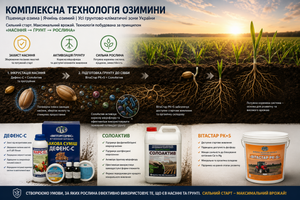
The purpose of the study is to develop theoretical, methodological provisions and practical recommendations for assessing the economic efficiency of pre-sowing encrustation of seeds of winter grain crops with phosphorus-containing preparations, in particular Defense S.
Results of the conducted studies. At the beginning of the 20th century, due to the expansion of the use of mineral fertilizers, interest in studying the influence of macro- and microelements on the process of seed germination increased significantly. From the extensive scientific experimental material it is clearly seen that the attention of most researchers was focused on pre-sowing treatment of seeds of winter grain crops with salts of orthophosphoric acid. This is due to the fact that these salts do not create a large osmotic pressure, because they had a relatively low salt index and therefore did not have a negative effect on seed germination. In addition, phosphorus, which is part of them, has a special role in metabolism, because it is one of the most important nutrients for seed germination. It is he who stimulates the rapid growth of the embryonic root. In this case, the following pattern is clearly manifested: the more available phosphorus is available at the start, the faster the plant will be able to independently extract water and nutrients from the soil solution during the growing season. It has now been established that the primary formation of organic substances in the germinating seed occurs with the participation of phosphates in these processes. This becomes possible due to an extremely important feature of orthophosphoric acid salts - the ability of their derivatives to form chemical bonds, which are carriers of a significant amount of energy in an easily accessible form.
During germination, the seedling does not have the opportunity to take the necessary amount of mobile phosphorus from the soil solution for two reasons: 1. low concentration of the soil solution; 2. The exudates secreted by primary roots have a low concentration and therefore are not yet able to convert soil gross forms of phosphorus into mobile ones and as a result, seedlings always experience a deficiency of mobile forms of phosphorus. Along with increasing seed germination and enhancing seedling growth, pre-sowing treatment with orthophosphoric acid salts has a positive effect on the subsequent processes of vital activity of soft winter wheat and winter barley. In this regard, pre-sowing seed encrustation with the introduction of phosphorus-containing preparations into the tank mixture Problems and prospects for financial support for the recovery of the economy of Ukraine 391 is increasingly used in agronomy and is widely implemented in production conditions.
The study was conducted in laboratory conditions taking into account the level of moisture supply and temperature regime, which were close to natural ones. For seed treatment, we chose the phosphorus-containing preparation Defense C, which was developed by Professor Serhiy KRAMARIOV and is now included in the “State Register of Pesticides and Agrochemicals Allowed for Use in Ukraine”. 300 grams of the phosphorus-containing preparation Defense C were added to the working solution prepared according to the manufacturers’ recommendations at the rate of 10 liters of aqueous solution used to treat one ton of seeds. The best options were selected from the laboratory experiments conducted, which were tested for their effectiveness in field experiments. The conducted studies showed that, along with increasing seed germination and enhancing seedling growth, pre-sowing treatment with orthophosphoric acid salts of the phosphorus-containing preparation Defense C also has a positive effect on the subsequent processes of plant life of soft winter wheat and winter barley. In this regard, pre-sowing seed encrustation with the introduction of phosphorus-containing preparations into the tank mixture is now increasingly used in agronomy.
Due to the additional amount of phosphorus-containing preparation Defense C applied to the surface of the seeds, the primary root system and the seedling of soft winter wheat did not experience a deficit in mobile forms of phosphorus for 20 days, which gave them the opportunity to form a powerful root system in the future, which in turn improved the conditions of mineral nutrition of plants, which positively affected the increase in yield. Due to the pre-sowing encrustation of seeds of winter grain crops, an additional increase in grain yield was obtained, which varied by year within 0.15–0.20 t/ha. At the current cost of 1 t of soft winter wheat grain of 8.0 thousand UAH, the cost of the obtained yield increase of 0.2 t/ha of grain will be 1.6 thousand UAH. The cost of the costs associated with the treatment of the sowing rate per hectare of soft winter wheat seeds of 220 kg/ha with 300 grams of the phosphorus-containing preparation Defense C is 69.0 UAH. The net profit obtained from the pre-sowing encrustation of soft winter wheat seeds with the phosphorus-containing preparation Defense C is 1660–69.0 = 1591 UAH. In this case, the investment.
Based on the materials of the II International Scientific and Practical Internet Conference.
PROBLEMS AND PROSPECTS OF FINANCIAL PROVISION OF ECONOMIC RECOVERY OF UKRAINE
MINISTRY OF EDUCATION AND SCIENCE OF UKRAINE
DNIPRO STATE AGRARIAN AND ECONOMIC UNIVERSITY
FACULTY OF ACCOUNTING AND FINANCE
DEPARTMENT OF FINANCE, BANKING AND INSURANCE
March 3-4, 2026
Dnipro 2026